

Result Anxiety Control: 8 Proven Ways to Stay Calm Before & After Results Day
Exam result stress, how to control result anxiety, result day fear, managing exam anxiety, result anxiety symptoms, coping with bad results
Let’s be honest — result anxiety hits differently than any other kind of stress.
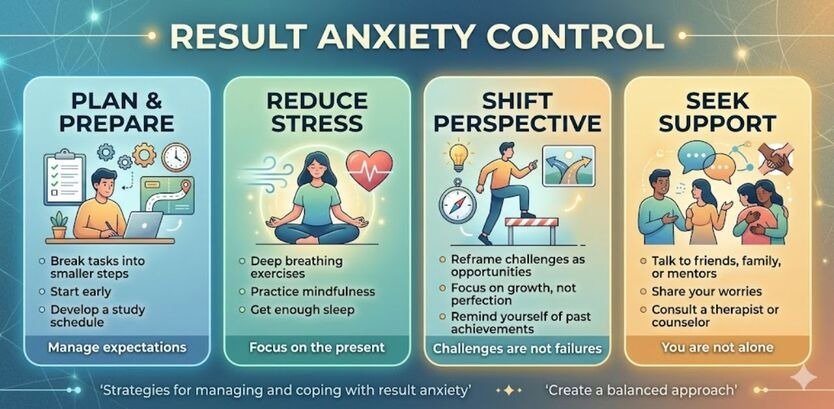
It’s not like being nervous before a presentation or worried about a job interview. This specific form of anxiety is a suffocating dread that creeps in at 2 AM and refuses to let you sleep. The experience involves constant phone-checking, replaying every answer you wrote, and a heavy feeling in your stomach that just won’t go away.
If that sounds familiar, you’re not alone — not even close. According to a 2022 survey by NCERT, around 80% of students go through result anxiety at some point. And yet, most of what you’ll find online is frustratingly shallow. “Just stay positive.” “Take deep breaths.” “It’ll be okay.”
Cool. But how?
This guide goes deeper — into the science, the psychology, and the real strategies that actually work for result anxiety control. Not just before results day, but during and after too.
Result anxiety is a form of performance anxiety but it’s unique because the fear isn’t about something you’re doing now. The worry focuses on something that has already happened and cannot be changed. This reality is exactly what makes it so mentally exhausting. You can’t study more. You can’t go back and rewrite. All you can do is wait. And that waiting? That’s where anxiety lives.
Here’s what result anxiety often looks like in real life:
-
You can’t sleep properly, or you sleep way too much
-
Constant phone checking happens even though results aren’t out yet
-
Appetite changes are common — either not eating, or stress-eating everything
-
You feel irritable with people who haven’t done anything wrong
-
Thoughts like “what’s the point of anything if I fail” quietly creeping in
And here’s the thing — none of this means you’re weak or dramatic. Your brain’s amygdala genuinely cannot tell the difference between a physical threat and an academic one. So when results day approaches, your brain literally treats it like danger. That’s why your chest feels tight and sleep becomes impossible. It’s not weakness. It’s biology.
8 Effective Ways for Result Anxiety Control
1. Stop Tying Your Worth to Your Grade
This is the most important thing in this entire article: your result is not your identity. A grade tells you how you performed on a specific set of questions, on one particular day. That’s it. It does not tell you how smart you are. Furthermore, it doesn’t measure your creativity, your resilience, your kindness, or your ability to grow. It is one data point in what is going to be a very long, very full story.
So when that thought appears — “If I fail, I’m a failure” — catch it. And replace it with something more honest: “If this doesn’t go the way I want, I’ll figure out the next step.” That single mindset shift is the foundation of all result anxiety control.
2. Use the Worry Window Technique
Here’s a technique that clinical psychologists recommend, and most people have never heard of it: the Worry Window. Give yourself exactly 10 minutes per day — set a timer — where you’re allowed to worry fully about your results. Let all the “what ifs” run wild. But when the timer goes off, you stop and move on to something else.
This works because it gives your anxiety a container. Instead of worry spreading across your entire day like an oil spill, it gets scheduled. You’re not denying the anxiety. You’re saying: “We’ll deal with you at 4 PM for 10 minutes. Not now.” Over time, the anxiety loses its power to ambush you because you’ve already given it a time slot.
4. Reset Your Nervous System With Box Breathing
When anxiety goes physical — heart pounding, hands shaking, chest tightening — no amount of positive thinking will help until your body calms down first. Box Breathing is used by surgeons, military personnel, and elite athletes for exactly this reason:
-
Inhale slowly for 4 counts
-
Hold for 4 counts
-
Exhale slowly for 4 counts
-
Hold for 4 counts
-
Repeat 4 to 5 times
This activates your parasympathetic nervous system — your body’s built-in “stand down” response. Within minutes, your heart rate slows and your thinking becomes clearer. It sounds almost too simple. But the physiology behind it is solid.
5. Keep a Routine Even If It Feels Pointless

When you’re anxiously waiting, structure feels almost offensive. Who cares about eating breakfast at the same time when your entire future feels uncertain? Here’s why it matters: routine signals safety to your nervous system. When your day has predictable rhythms, your brain interprets that as evidence that life is stable — which is the exact opposite of what anxiety needs to keep running.
You don’t need a complicated schedule. Just anchor your day with a few consistent habits. Get outside once a day. Eat actual meals. Spend time on something you enjoy — even if you don’t feel like enjoying anything right now. The doing comes before the feeling, not after.
6. Stop the Comparison Spiral
Ask yourself honestly: have you ever felt better after comparing your exam answers with a classmate? Probably not. Post-result comparison conversations are one of the most anxiety-amplifying habits students fall into. Hearing that someone else thinks they did brilliantly when you’re not so sure? That is never helpful. Such talk is simply fuel for your anxiety.
During the waiting period, give yourself permission to do a comparison detox: mute exam-related social media, gently change the subject when conversations head that direction, and spend more time with people who make you feel settled rather than competitive. Everyone’s circumstances are different. Comparison was never a fair game.
7. Talk About It Seriously
This one gets dismissed more than it should. Just talking — to a friend, a sibling, a parent, a teacher — genuinely reduces anxiety. Not because talking changes the result, but because anxiety thrives in isolation. The moment you say it out loud, it loses some of its weight.
You don’t need to have it all figured out before you speak. Just saying “I’m really stressed about my results and I don’t know how to handle it” to someone who cares about you is enough. If talking to someone you know feels too exposed, many schools and universities offer anonymous support lines and online counseling. You don’t need to be in crisis to use them.
8. Protect Your Sleep, Food, and Movement
These three sound boring. But they are the infrastructure that everything else runs on. Sleep: Even one poor night of sleep makes your amygdala up to 60% more reactive. You feel more anxious, more irritable, and less able to think clearly. Protect your sleep — because it genuinely matters. Food: Avoid leaning on caffeine and energy drinks during anxious periods. They spike cortisol — your stress hormone — which makes anxiety worse

. Eat real, balanced meals to keep your blood sugar and mood stable. Movement: A 20-minute walk releases endorphins, reduces cortisol, and gives your nervous system somewhere to put all that restless energy. Physical activity doesn’t require a gym. You just need to move.
Common Questions About Result Day Stress
-
Q: Why do I feel physically sick before result day? A: Your body is responding to perceived threat the way it’s built to. Nausea, headaches, and that knot in the stomach are all genuine stress responses. Box breathing, staying hydrated, and cutting caffeine in the 48 hours before results day can meaningfully reduce these symptoms.
-
Q: How do I manage anxiety after getting bad results? A: First, let yourself feel the disappointment — don’t rush past it. Then, within a day or two, shift toward action. What are your realistic options? A resit, a different course, a new path? Bad results close some doors. They don’t close all of them.
-
Q: Is result anxiety a mental health condition? A: Not on its own — it’s a normal human response to uncertainty. However, if anxiety is persistent and preventing you from functioning in daily life, speaking to a professional is worth it. Cognitive Behavioral Therapy (CBT) has strong evidence behind it for exactly this kind of anxiety.
-
Q: How can parents help a child with result anxiety? A: The most powerful thing is to genuinely mean it when you say your love and support don’t depend on the grade. Listen more than you advise. Let your child know you’ll face whatever outcome together.
Final Thoughts on Finding Peace
Result anxiety is not a character flaw. It means you care — and caring about your future is not a problem. The strategies here aren’t magic. They’re skills. And like all skills, they get more effective the more you practice them. So pick one thing from this list. Try it today. Then try it again tomorrow.
You’ve already done the hard part. Now take care of yourself while you wait.
If you’re experiencing severe anxiety that feels unmanageable, please reach out to a mental health professional or your school or university’s counseling service.