Pre-Exam Calmness: The Ultimate Guide to Staying Cool Under Pressure
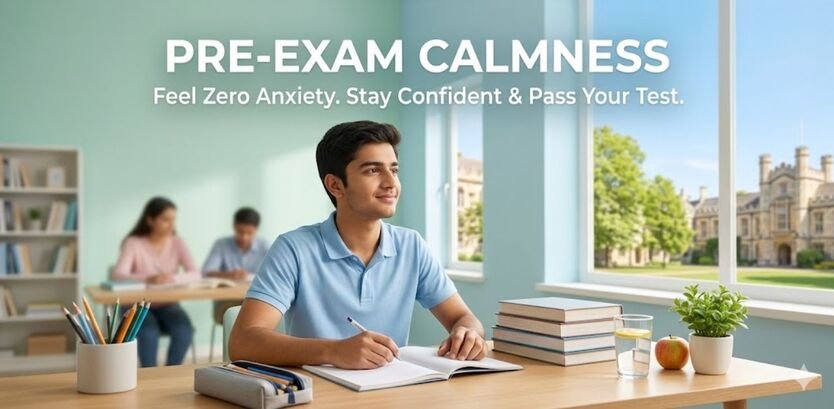
Achieving pre-exam calmness is the best way to make sure you do well on your test without feeling stressed. We have all been there: the clock is ticking, the exam is tomorrow, and your heart is beating like a drum. Your palms are sweaty, and suddenly, you feel like you have forgotten everything you studied. Therefore, learning how to maintain pre-exam calmness will help you walk into the exam room feeling like a champion instead of a nervous wreck.
Pre-exam calmness is the secret weapon of high-achieving students. It is not about how much you know; it is about how your brain performs under pressure. In this guide, we will dive deep into techniques that go beyond just “studying hard.” We will look at science-backed ways to hack your brain and body for total peace.
1. Understanding Stress to Achieve Pre-Exam Calmness
Before we talk about calmness, we must understand why we feel stressed. When we are scared of an exam, our body releases a hormone called cortisol. This is part of the “fight or flight” response. Specifically, your brain thinks the exam is a physical danger, like a lion chasing you.
Consequently, your “thinking brain” (the prefrontal cortex) shuts down, and your “emotional brain” (the amygdala) takes over. This is why you “blank out” during a test. To achieve pre-exam calmness, we have to tell our brain that there is no lion. We have to prove to our body that we are safe.
2. Activating Your Body’s Pre-Exam Calmness Switch
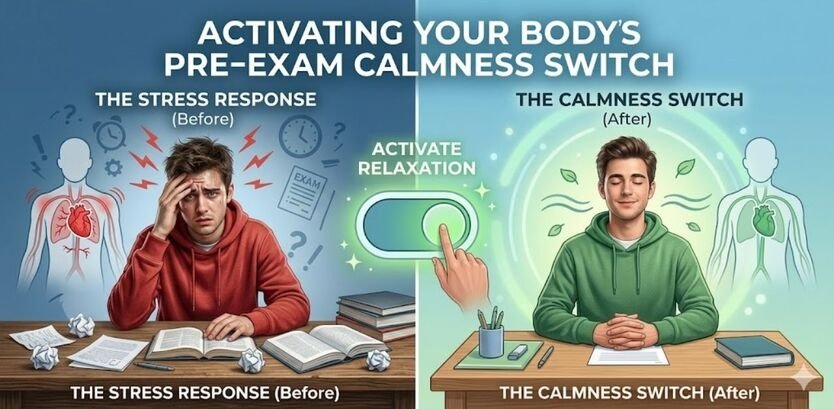
Most websites tell you to “take a deep breath,” but they don’t explain why. Deep in your body, there is a long nerve called the Vagus Nerve. Think of it as a “reset button” for stress.
Moreover, you can manually trigger this nerve to force your body to relax. One remarkable way to do this is through Box Breathing.
-
Breathe in for 4 seconds.
-
Hold for 4 seconds.
-
Exhale for 4 seconds.
-
Wait for 4 seconds.
In addition to breathing, splashing cold water on your face or humming a low tune can also wake up the Vagus Nerve. When you do this, your heart rate slows down instantly. This is a physical hack that works even if your mind is still racing.
3. Beating “Decision Fatigue”
One thing most competitors don’t mention is Decision Fatigue. Every time you make a choice—what to wear, what to eat, which pen to use—you use up a little bit of “brain fuel.”
If you spend the morning of your exam making twenty small decisions, your brain will be tired before you even see the first question. Therefore, the key to pre-exam calmness is to remove all decisions for 24 hours.
-
Pick your clothes the night before.
-
Pack your bag completely (pens, ID, water).
-
Decide your breakfast in advance.
By doing this, you save all your mental energy for the actual exam. You walk into the hall with a full tank of “brain fuel.”
4. How a “Brain Dump” Helps You Stay Calm Before Exams
One of the biggest causes of stress is the fear of forgetting a specific formula or date. This creates “mental clutter.”
Actually, you can fix this by using a Brain Dump. As soon as you sit down at your desk (if allowed) or just before you leave home, write down every “scary” fact on a piece of scrap paper. Once it is on paper, your brain stops worrying about holding onto it. Consequently, this clears up space in your working memory, allowing you to focus on logic and understanding rather than just memorization.
5. Avoiding Social Stress for Total Pre-Exam Calmness
Have you ever stood outside an exam hall and listened to dosto (friends) talk about how hard the paper will be? This is called Social Looping. Stress is contagious. If the people around you are panicking, your brain will mirror that panic.
Nevertheless, many students think they need to talk to their peers to feel supported. This is often a mistake. To maintain pre-exam calmness, you should try “The Silent Entry.”
-
Avoid the crowds outside the hall.
-
Listen to calming music or an audiobook.
-
Do not discuss the syllabus right before the test.
Ultimately, your goal is to stay in your own “mental bubble” until the paper is on your desk.
6.Best Foods for Exam Anxiety Relief and Focus
Everyone says “eat a good breakfast,” but what does that really mean? If you eat a big bowl of sugary cereal, your blood sugar will spike and then crash. As a result, you will feel tired and shaky halfway through the exam.
Instead, focus on “Brain Foods” that release energy slowly:

-
Oats or Eggs: They keep your energy steady.
-
Walnuts: These are great for memory.
-
Hydration: Even a 2% drop in water can lead to a big drop in focus.
Furthermore, avoid too much caffeine. While a little coffee helps, too much makes your hands shake and increases your anxiety. Stick to what your body is used to.
7. Visual Tricks for Instant Pre-Exam Calmness
Here is a secret trick that many professional athletes use. When we are stressed, our vision becomes “tunnel vision.” We focus hard on one thing, and our muscles get tight.
To trigger pre-exam calmness, try to use Peripheral Vision. Look at a point on the wall, and then, without moving your eyes, try to notice the things to the left and right of you. Simultaneously, try to see the floor and the ceiling in your “side vision.”
Remarkably, this physical act of widening your vision tells your nervous system to relax. It is almost impossible to feel a full panic attack while maintaining wide, peripheral vision.
8. The Half-Day Rule: A Secret to Staying Calm Before Tests
A common mistake is studying until 2:00 AM. In reality, the last 5 hours of “cramming” are usually useless. Your brain is too tired to store new information.
Specifically, you should follow the Half-Day Rule. Stop all heavy studying by 6:00 PM the night before. Use the evening to watch a light movie, go for a walk, or talk to family about non-exam topics. This gives your brain time to move the information you learned from “temporary storage” to “permanent memory.”
9. Turning Nervousness into Pre-Exam Calmness
Did you know that the physical feeling of anxiety (fast heart, fast breathing) is exactly the same as the feeling of excitement? The only difference is what your mind calls it.
Instead of saying “I am nervous,” try saying “I am excited to show what I know.” Research shows that students who “re-frame” their stress as excitement actually perform better. They use that extra energy to focus harder rather than letting it turn into fear.
10. A Morning Ritual Designed for Pre-Exam Calmness

To ensure total pre-exam calmness, your morning should feel like a slow-motion movie. No rushing. No shouting.
-
Wake up early: Give yourself an extra 30 minutes.
-
No Screens: Avoid social media. You don’t want to see a stressful post or news story.
-
Light Movement: A 5-minute stretch or walk gets the blood flowing to your brain.
-
Positive Affirmation: Say one simple sentence: “I am prepared, and I am calm.”
11. Staying Calm During the Test: Quick Panic Relief
Even with the best preparation, you might hit a question that looks impossible. Suddenly, the panic starts to rise.
When this happens, do not keep staring at the question. Put your pen down for 30 seconds. Look away from the paper. Take two “Box Breaths.” Then, move on to an easier question. Once you get a few easy points, your confidence will return, and the “impossible” question will often seem much simpler when you come back to it later.12. Summary:
The Calm Student’s Checklist
To wrap everything up, remember that pre-exam calmness is about Control. You cannot control the questions on the paper, but you can control your environment, your body, and your reaction.
-
Physical: Use the Vagus Nerve hacks (breathing and vision).
-
Environmental: Prepare everything the night before to avoid decision fatigue.
-
Social: Stay away from “stress-looping” friends.
-
Mental: Use Brain Dumps to clear mental clutter.
Conclusion:
Achieving pre-exam calmness is not about being perfect; it is about being prepared—both in your mind and your body. By using simple techniques like the 5-4-3-2-1 method, organizing your morning, and eating the right foods, you can turn your stress into focus.
Remember, an exam is just a snapshot of your knowledge at one moment. It does not define your entire future or your worth. When you walk into that hall with pre-exam calmness, you are giving your brain the best possible chance to show what you really know. Take a deep breath, trust your hard work, and stay cool. You’ve got this!
Frequently Asked Questions
1. What is the quickest way to achieve pre-exam calmness?
The fastest way is through controlled breathing. Use the Box Breathing technique: breathe in for 4 seconds, hold for 4, and exhale for 4. This tells your nervous system to stop the “fight or flight” response and start relaxing instantly.
2. How many hours of sleep do I need for pre-exam calmness?
For your brain to function at its peak, you should aim for 6 to 8 hours of sleep. Sleep helps move information from your short-term memory to your long-term memory, which reduces the fear of forgetting.
3. Can certain foods help reduce exam anxiety?
Yes! Foods rich in Omega-3 (like walnuts) and complex carbohydrates (like oats) provide steady energy to your brain. Avoid sugary snacks or too much caffeine, as they can lead to energy crashes and make you feel more jittery.
4. What should I do if I blank out during the exam?
If you feel a panic moment, stop writing. Close your eyes for 30 seconds and focus only on your breath. Use your peripheral vision to look around the room. Moving to an easier question first can also help rebuild your confidence and bring back your memory.
5. Why does talking to friends before an exam cause stress?
This is called “Social Looping.” When you see others panicking, your brain’s mirror neurons make you feel that same stress. To maintain pre-exam calmness, it is best to avoid syllabus discussions at least two hours before the test begins.