

The Ultimate Guide to Exam Stress Management (2026)
In general, students always feel weighed down with something as the examination season approaches. It is natural to experience fatigue, anger, and stress during such periods. But once you learn how to cope with the Management of Exam Stress techniques in time, there is no need to worry because everything will turn out fine.
In this detailed article, we will uncover some strategies used by experienced students to manage their Exam Stress. You will be introduced to new tips that have not been highlighted in any other online source and have strong ties to your brain scientifically. The main purpose of our guide is not just limited to learning, but it will ensure your success in the exams with a calm mind. We are going to offer you a roadmap through which you can take part in tough exams without any fears.

Not only will this article help you pass the test, but it will also enhance your mental health conditions. That is why it is important to shed light on the reasons that make it crucial to keep our minds healthy by avoiding Exam Stress.
1. Why Exam Stress Management is Important (The Real Science)
Stress is your body’s built-in “Alarm System.” When you have a big test, your brain releases a chemical called Cortisol. In addition, it is important to know that this is not your enemy. In fact, there are two types of stress that every student should understand.
Understanding Eustress vs Distress
- Good Stress (Eustress): This type of stress sharpens your focus and speeds up your thinking. It makes you feel alert and ready to work.
- Bad Stress (Distress): On the other hand, bad stress floods the brain with too much cortisol. This actually blocks the memory center (called the Hippocampus) from working properly.
What competitors don’t tell you: There is a real biological reason why you sometimes “go blank” in an exam room. It is not because you are not smart; instead, it is because cortisol overload is temporarily blocking your memory center. The good news is that deep breathing can reduce these cortisol levels in under 60 seconds. Therefore, our goal for Exam Stress Management is to keep cortisol at the right level—not zero, and not maximum.
2. Neuroscience Secrets for Exam Stress Management
A. Your Brain Has a “Threat Mode” — And You Can Switch It Off
When you panic, your brain activates the Amygdala (the fear center). Consequently, it literally hijacks your rational thinking brain. This is exactly why you might study for weeks but still freeze in the exam hall. To fix this, you need a physical way to tell your brain that you are safe.
The Fix — The 3-3-3 Brain Reset: When you feel panic, do this immediately:

- Look at 3 things around you (e.g., a blue pen, a wooden desk, a white wall).
- Listen for 3 sounds (e.g., a bird, a car, your own breathing).
- Move 3 body parts (tap your toes, roll your shoulders, wiggle your fingers).
Because this forces your “Prefrontal Cortex” to re-engage, it overrides the panic signal. As a result, most students experience calm within 90 seconds. Moreover, you can do this even while sitting in the exam hall without anyone noticing.
3. Best Daily Plans for Exam Stress Management
The “3-3-3” Daily Plan
To avoid feeling overwhelmed, you should simplify your day. Every morning, write down only:
- 3 Hours of Deep Study: Tackle your hardest subject first (this is called “Eating the Frog”).
- 3 Urgent Tasks: Complete a specific chapter, a past paper, or a project section.
- 3 Easy Tasks: Organise your notes, clean your desk, or review flashcards.
By doing this, you prevent the common student trap of feeling busy all day but finishing nothing important. Consequently, your confidence will grow as you tick off these tasks.
Active Recall — Stop Re-Reading, Start Testing Yourself
Reading a textbook chapter 5 times gives you an “illusion of knowledge.” In other words, your brain recognizes the words but cannot retrieve the information during an exam. To combat this, you must use Active Recall.
4. Real Life Solutions for Exam Stress Management
Handling Exam Performance Anxiety
“I know the content but I panic in the exam room.” This is a “retrieval problem.” Basically, the knowledge is there, but stress is blocking the door. The best fix is “Expressive Writing.” For example, spend 10 minutes writing down all your fears right before the exam. By doing this, you offload anxious thoughts from your memory, freeing up space for the actual exam answers.
5. Physical Health Hacks (The Body-Brain Connection)
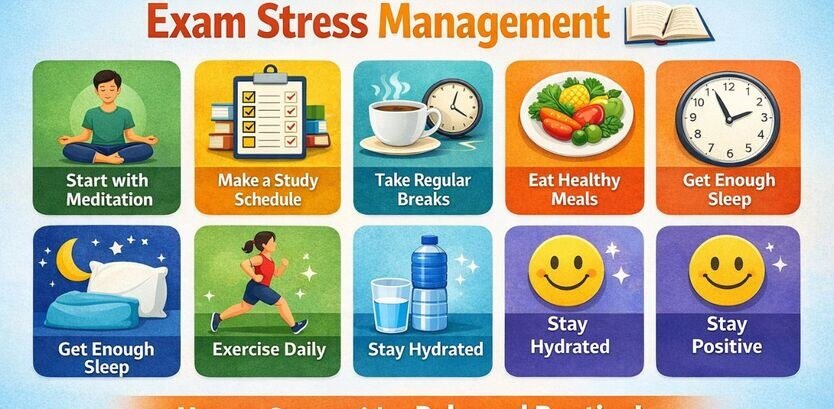
The Water Sip Rule
Your brain is 75% water. Therefore, even a tiny drop in hydration reduces your concentration. Instead of drinking a whole bottle at once, take small sips every 20 minutes. This keeps your brain’s “electric signals” moving fast.
The Brain Dump — Night Routine
At 10 PM, your brain naturally starts rehearsing tomorrow’s worries. To stop this, write tomorrow’s to-do list on paper before bed. Once the list is on paper, your brain “saves the file” and stops looping the worries. Consequently, you will fall asleep much faster.
6. Easy Tips for Exam Stress Management on Test Day
Avoid the “Panic Group”
Furthermore, every exam hall has a group of students standing outside panicking. Since stress is neurologically contagious, you should stay away from them. Instead, find a quiet corner and listen to calm music or just breathe.
The First 5 Minutes Rule
When you receive the paper, do not start writing immediately. Instead, spend the first 5 minutes reading everything. Specifically, find the easiest questions first. When you answer an easy question successfully, your brain releases Dopamine, which gives you the confidence to tackle the harder ones later.
7. The Power of Your Mindset

One secret of successful Exam Stress Management is changing how you think about your brain. Actually, your (brain) is like a muscle; the more you train it to stay calm, the stronger it becomes. Instead of looking at the exam as a scary monster, try to see it as a chance to show what you have learned. When you feel a little bit of stress, tell yourself that your body is just getting “pumped up” to perform better. Consequently, this small change in your thinking will lower your cortisol and help you think much faster during the test. Indeed, a positive mindset is often the best study tool you can ever have.
8. Summary: Your Exam Stress Management Checklist
To make sure you are ready, follow this simple checklist:
- ✅ Identify your Chronotype and study at your best time.
- ✅ Use the 3-3-3 Reset if you feel panic.
- ✅ Switch your phone to Grayscale to stay focused.
- ✅ Use Active Recall instead of just reading.
- ✅ Take 5-minute breaks every half hour.
- ✅ Sleep 7 hours to save your memory.
- ✅ Start with the easiest questions in the exam hall.
9. Conclusion:
In conclusion, mastering Exam Stress Management is not about removing stress entirely, but learning how to handle it effectively. As we have discussed, using techniques like the 3-3-3 rule and the Feynman technique can change how your brain reacts to pressure. Furthermore, focusing on your physical health through better sleep and hydration will give you a natural edge during the paper season.
Ultimately, remember that an exam is just a test of your memory on a specific day; however, it does not define your whole future. Therefore, trust your preparation, follow these science-backed hacks, and walk into the exam hall with a calm mind. You have the tools now—go and give it your best shot!
10. Frequently Asked Questions
1. What is the fastest way for Exam Stress Management?
The fastest way to manage sudden panic is the 3-3-3 rule. Specifically, you should look at 3 things, listen for 3 sounds, and move 3 body parts. This technique forces your brain to stay in the present moment and reduces cortisol levels in under 90 seconds.
2. Does sleeping help in Exam Stress Management?
Yes, absolutely. Sleep is crucial because it allows your brain to perform “Memory Consolidation.” In other words, while you sleep, your brain saves everything you studied into long-term memory. Therefore, getting at least 6-7 hours of sleep is better than staying up all night.
3. How can I stop forgetting everything during the exam?
Forgetting usually happens because of high stress blocking your memory center. To fix this, use Active Recall while studying—test yourself instead of just reading. In addition, writing about your fears for 10 minutes before the exam can help clear your mind and improve focus.
4. Can my diet affect Exam Stress Management?
Indeed, what you eat matters. Dehydration and lack of magnesium can make you feel more anxious. For instance, drinking small sips of water and eating magnesium-rich foods like bananas can keep your brain sharp and calm during stressful days.