

Daily Study Routine for Students: Step-by-Step Guide to Study Smarter and Stay Consistent
A daily study routine is essential for every student who wants to improve focus, manage time better, and achieve higher exam results. Most students fail not because they are not intelligent, but because they do not follow a proper daily study routine. With a clear daily study routine, you can study smarter, reduce stress, and make consistent progress every day.
What Is a Daily Study Routine and Why It Matters for Students

Whether you are a school student, a college student, or someone preparing for a competitive exam, a well-planned study schedule can completely transform your results. As a result, students who follow a fixed routine consistently outperform those who study randomly.
In this guide, you will find everything you need — from building your own daily study routine from scratch, to sample timetables, proven study techniques, and focus tips that even top-scoring students rely on. In other words, no complicated language, no useless filler — just real, practical steps you can start using today.
What Is a Daily Study Routine?
A daily study routine is a structured plan that guides how you spend your study time each day. More specifically, it includes:
- What subjects will you study
- At what time will you study each one
- How long each subject gets
- When will you take breaks and rest
It Works Like a Roadmap
Think of it like a roadmap. Without it, you are just wandering. With it, on the other hand, you know exactly where you are going and how to get there.
Furthermore, a good study routine does not mean studying ten hours without stopping. Rather, it means studying smartly at the right times, in the right order, with the right breaks in between.
Why a Daily Study Routine Changes Everything
 Many students skip making a study plan and then wonder why they feel panicked before every exam. To understand the real impact, here is what a proper daily study schedule actually does for you.
It Reduces Stress and Builds Confidence
- Reduces stress and panic — When you have a plan, you know everything will be covered. As a result, there is no need for last-minute cramming the night before.
- Builds confidence — Completing your daily plan feels good. Moreover, that small win every day motivates you to keep going and do even more.
It Saves Time and Improves Memory
- Saves time — No more sitting at your desk for twenty minutes wondering what to study next. Instead, you already know exactly what comes next.
- Improves memory — Regular revision built into your routine helps your brain store information for the long term, not just until the exam.
It Creates Balance and Builds Strong Habits
- Creates balance — In addition to study time, a well-made routine includes time for hobbies, family, exercise, and sleep.
- Build a strong study habit — When you study at the same time every day, your brain gets trained. Consequently, sitting down to study becomes easier and more natural over time.
How to Create a Daily Study Routine Step by Step
You do not need to copy anyone else’s timetable. In fact, the best study routine is the one that fits you. Here is how to build one from scratch.
Step 1: Identify Your Peak Energy Hours
First of all, ask yourself — when do I feel most alert and focused? Early morning? Late afternoon? Night?
- Morning learners — Schedule your hardest subjects between 6 AM and 10 AM.
- Night learners — Do your most serious studying between 8 PM and 11 PM.
In either case, always place your most difficult subject during your highest-energy hours. Never save the hard work for when you are already tired.
Step 2: List Every Subject and Topic You Need to Cover
Next, write everything down. Then rank your subjects:
- Which ones are the hardest for you?
- Which topics need the most revision?
- Which subjects are you already confident in?
Based on this list, give the most time to your weak areas. Do not spend two hours on a subject you already understand well.
Step 3: Decide How Many Hours You Will Study Each Day
After that, decide how many hours you can realistically study each day. Do not overload yourself. Here is a healthy guideline:
| Student Level: Recommended | d Daily Study Hours |
| Class 6 to 8 | 2 to 3 hours |
| Class 9 to 10 | 3 to 5 hours |
| Class 11 to 12 | 5 to 7 hours |
| College or Competitive Exam | 6 to 8 hours |
Always remember: quality matters more than quantity. Three focused hours beat six distracted ones every single time.
Step 4: Divide Your Time Across Subjects
Once you know your total study hours, divide them across your subjects. For example, if you have five subjects and five hours, give at least one hour to each. Then adjust based on difficulty:
- Weak or difficult subject → 1.5 to 2 hours
- Strong or easy subject → 30 to 45 minutes for quick revision
Step 5: Schedule Short Breaks
Equally important is planning your breaks. Your brain needs rest to absorb what it has just learned. A simple rule to follow:
Study for 45 to 50 minutes → Take a 10 to 15 minute break
During your break, drink water, take a short walk, or eat a light snack. However, avoid scrolling social media — it overstimulates your brain and makes it much harder to refocus afterwards.
Step 6: Include Daily Revision Time
In addition to studying new topics, you must revise old ones every day. Most students study new content daily, but never go back to review it. That is exactly why they forget things so quickly.
Therefore, set aside at least 30 to 45 minutes every evening to review what you studied that day. This single habit can double how much you actually remember by exam time.
Step 7: Set a Fixed Sleep Time and Keep It
Finally, fix a sleep time and stick to it every night. Sleep is not wasted time. On the contrary, it is the period when your brain consolidates and stores everything you studied.
- Aim for 7 to 8 hours of sleep every night
- Go to bed at the same time every night to build a healthy sleep rhythm
- Moreover, avoid studying in the last 30 minutes before bed — give your brain time to wind down properly
Best Daily Study Routine for Students (Sample Timetable)
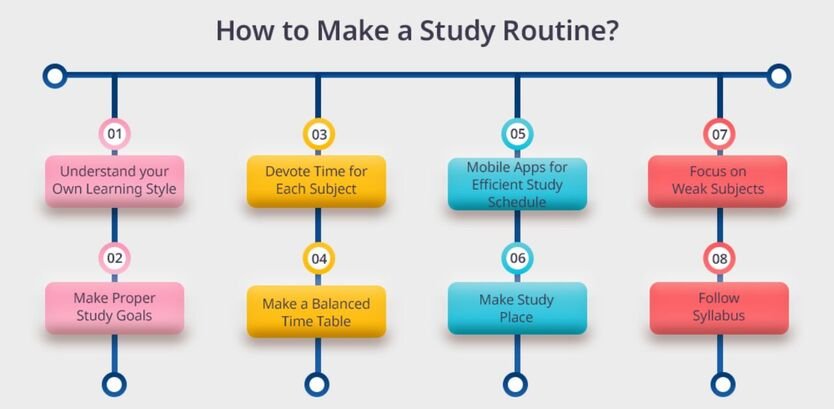
Here is a practical, well-balanced daily study schedule that most students can follow. Of course, feel free to adjust the timings to match your own life.
Full Day Study Timetable
| Time | Activity |
| 5:30 AM – 6:00 AM | Wake up and freshen up |
| 6:00 AM – 6:30 AM | Light exercise, walking, or stretching |
| 6:30 AM – 8:30 AM | Study Session 1 — Most difficult subject |
| 8:30 AM – 9:00 AM | Breakfast |
| 9:00 AM – 11:00 AM | Study Session 2 — Second subject |
| 11:00 AM – 11:15 AM | Short break |
| 11:15 AM – 1:00 PM | Study Session 3 — Third subject or practice questions |
| 1:00 PM – 2:00 PM | Lunch and rest |
| 2:00 PM – 4:00 PM | Study Session 4 — Weak topics or past papers |
| 4:00 PM – 5:00 PM | Free time, a hobby, or an outdoor walk |
| 5:00 PM – 7:00 PM | Study Session 5 — Daily revision |
| 7:00 PM – 8:00 PM | Dinner and family time |
| 8:00 PM – 9:30 PM | Light reading or notes review |
| 9:30 PM – 10:00 PM | Plan tomorrow’s study session |
| 10:00 PM – 10:30 PM | Wind down — no screens |
| 10:30 PM | Sleep |
How to Adjust This Timetable
This timetable is a sample, not a strict rule. Therefore, adjust the timings to fit your school or college schedule, your family routine, and your personal energy pattern. The goal is to create a plan you can actually follow every day.
Daily Study Routine for School Students (Class 9 to 12)
School students face a unique challenge — they spend most of the day in class and still need to study at home afterwards. However, with the right plan, it is completely manageable.
Morning and After-School Study Plan
| Time | Activity |
| 5:30 AM – 6:30 AM | Morning study — quick revision or exam prep |
| 6:30 AM – 7:30 AM | Get ready for school |
| During School | Pay full attention in every class — this alone cuts your home study time in half |
| 4:30 PM – 5:00 PM | Come home, eat, and relax — no study yet |
| 5:00 PM – 7:00 PM | Homework and today’s school topics |
| 7:00 PM – 8:00 PM | Dinner and rest |
| 8:00 PM – 9:30 PM | Self-study — weak subjects or exam preparation |
| 9:30 PM – 10:00 PM | Quick daily revision |
| 10:30 PM | Sleep |
The Most Underrated Study Tip for School Students
Paying full attention in class is one of the most powerful things a school student can do. Specifically, if you truly understand something during the lesson, you need far less time to revise it at home later. As a result, your evening study sessions become shorter and much more effective.
The Pomodoro Technique — Simple and Highly Effective

The Pomodoro Technique is one of the most widely used study methods in the world. Furthermore, it works precisely because it is so simple and easy to start immediately.
How the Pomodoro Technique Works
- First, set a timer for 25 minutes
- Then study with complete focus — no phone, no distractions
- When the timer rings, take a 5-minute break
- After that, repeat this four times
- Finally, after four rounds, take a longer 20 to 30-minute break
This works because your brain performs best in short, focused bursts. In addition, knowing that a break is just minutes away makes it much easier to stay on task right now.
Best Free Apps for Pomodoro
- Forest — blocks your phone while you study
- Focus To-Do — combines Pomodoro with a task list
- Be Focused — simple and clean timer app
2/3/5/7 Method to Strengthen Your Daily Study Routine
The 2/3/5/7 method is a spaced repetition strategy designed to move information into your long-term memory.
The Four Revision Days
- Day 1: Study the topic for the first time
- Day 2: Revise it
- Day 5: Revise it again
- Day 7: Do a final revision
After completing all four steps, that information becomes deeply embedded in your memory. As a result, you will not easily forget it even weeks later.
Who Should Use This Method?
This method is especially powerful for board exams and competitive tests where you need to remember a large volume of content. In addition, it works well for any subject that requires understanding of facts, formulas, dates, or definitions.
7-3-2-1 Method for Exam Preparation in Your Daily Study Routine
This is an excellent strategy to use in the final week before any exam. In fact, many successful students rely on this exact approach to stay calm and organised.
The 7-3-2-1 Plan Explained
- 7 days before the exam: Finish the entire syllabus
- 3 days before: Revise all topics once completely
- 2 days before: Focus only on your weak and difficult topics
- 1 day before: Review your short notes, rest well, and sleep early
As a result of following this plan, last-minute stress is greatly reduced. Consequently, your mind stays calm and fully ready on exam day.
Study Smarter, Not Harder
- Write more and read less. Writing actively engages more areas of the brain than passive reading. Therefore, use notes, summaries, mind maps, and diagrams to interact with the material.
- Study one subject per session. Jumping between three subjects in one hour divides your attention. Instead, give one subject your full, undivided focus.
- Tell someone your plan for the day. For example, saying out loud “I will finish Chapter 5 today” makes you significantly more likely to follow through.
Common Daily Study Routine Mistakes Students Must Avoid
Even hardworking students fall into these traps. Therefore, it is important to recognise them early and fix them before they become habits.
Mistakes That Waste Your Time
- Studying for hours without any breaks. In reality, your brain stops absorbing information effectively after about 45 to 60 minutes.
- Starting with the easiest topics. Always tackle hard subjects first, when your energy is at its peak. Save the easier work for later.
- No revision built into the routine. Studying new material every day without revisiting old topics means you will forget most of it before the exam.
Mistakes That Break Your Routine
- Making the timetable too rigid. As a result of being too strict, many students quit their routine after just a few days. Build in flexibility.
- Comparing yourself to others. Above all, build a routine that works for you, not anyone else.
- Neglecting physical health. In short, your body and brain are deeply connected. Take care of both.
How to Build a Daily Study Routine That Actually Sticks
Creating a routine is the easy part. However, maintaining it over weeks and months is where most students struggle.
Start Small and Build Gradually
- Start with a smaller commitment. To begin with, study just one to two hours a day. Once it feels comfortable, gradually increase the time.
- Study at the same time every day. After roughly 21 days of repetition, the routine starts to feel completely automatic.
Track Progress and Stay Accountable
- Track your daily progress. For example, use a simple notebook or habit-tracking app. Ticking off completed tasks is surprisingly powerful motivation.
- Avoid breaking the chain. Missing one day is recoverable. However, missing two in a row often breaks the habit entirely.
Review and Improve Every Week
- Review your routine every week. Ask yourself what is working and what is not. Then adjust accordingly. A good routine should evolve as your needs change over time.
Best Apps to Improve Your Daily Study Routine

Fortunately, you do not need expensive tools. These free apps are genuinely useful and easy to get started with
| App | What It Does |
| Google Calendar | Plan and visualise your daily study schedule |
| Forest | Pomodoro timer combined with a phone-blocking feature |
| Notion | Organise your notes, to-do lists, and study plans |
| Anki | Flashcard-based spaced repetition for long-term memory |
| Todoist | Simple daily task lists with reminders |
| Focusmate | Study alongside other students online for accountability |
The Ultimate Daily Study Routine Checklist for Students
Finally, use this quick checklist at the end of every study day:
- ☐ Did I complete all the subjects I planned for today?
- ☐ Did I revise what I studied yesterday?
- ☐ Did I take proper breaks between sessions?
- ☐ Did I drink enough water and eat well today?
- ☐ Have I written out tomorrow’s study plan?
- ☐ Am I going to bed at my regular sleep time tonight?
If you can honestly tick most of these boxes, then you had a productive and healthy study day.
Conclusion
A daily study routine is, without doubt, one of the most powerful tools a student can build for themselves. It does not need to be elaborate or perfect. It simply needs to be yours.
Start Today — Not Tomorrow
So start today. Even a simple plan — two focused hours with proper breaks and a little revision at the end — is infinitely better than no plan at all. Ultimately, the students who score well are the ones who show up every single day with a clear plan and the discipline to follow it.
Your 24 Hours Are Enough
You have the same 24 hours as every top student in the world. The only question is what you choose to do with them. Therefore, build your routine, follow it, improve it over time — and the results will most certainly follow.
FAQS
Q1: How many hours should a student study every day?
Ans: Most students should study for 3 to 4 hours daily to get good results. However, focusing hard for a short time is better than sitting for many hours with distractions.
Q2: What is the best time of the day to start studying?
Ans: The best time is when you feel most energetic and awake, like early morning or evening. You should pick a time when your brain is fresh so you can understand difficult topics easily.
Q3: Is it good to study only one subject all day long?
Ans: No, it is better to study 2 or 3 different subjects each day to keep your brain active. Changing subjects prevents boredom and helps you stay interested in your work for a longer time.
Q4: How does the Pomodoro Technique help me focus better?
Ans: This technique asks you to study for 25 minutes and then take a short 5-minute break. These small breaks keep your mind fresh and stop you from feeling too tired while learning.
Q5: What should I do if I miss my study routine for one day?
Ans: Do not worry or feel stressed if you miss a day because of some work. Just start again the next day and try to stay consistent with your plan from that point.